
Canadian Work Brief
Canada’s Job Market: Job Ads vs. Employment
Indeed job ads fell 6.3% between January and September while employment was nearly flat. Both measures were slightly higher than a year earlier. Here is what the distinction means for your hiring plan.
Jobs.ca analysis · November 4, 2026
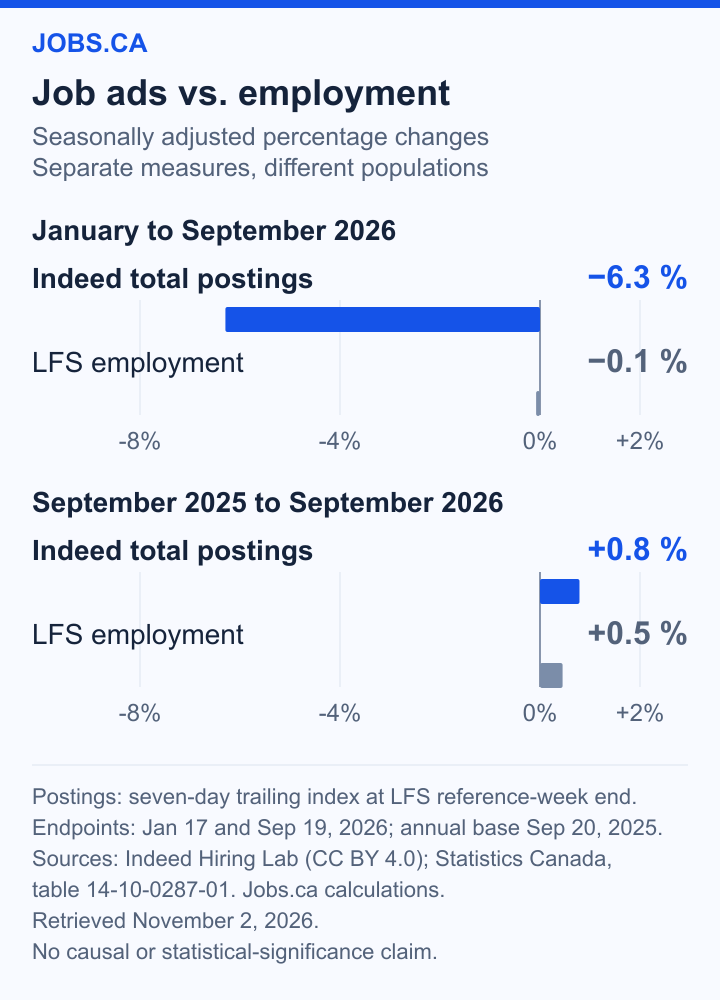
Sources: Indeed Hiring Lab and Statistics Canada, table 14-10-0287-01; Jobs.ca calculations. Download the exact chart data. Both series are seasonally adjusted, but describe different populations. No significance or causal claim is made.
Use this chart
Citation: Jobs.ca calculations using Indeed Hiring Lab and adapted from Statistics Canada, Labour Force Survey, September 2026; source vintage November 2, 2026. This does not constitute an endorsement by Statistics Canada of this product. Canada’s job ads and employment: two comparisons. https://www.jobs.ca/blog/canada-job-market-job-ads-vs-employment-2026#chart
Original sources: Indeed Hiring Lab · Statistics Canada
Open chart imageDownload the plotted data

Copy this HTML to embed the chart with its citation and link. Original-source terms apply.
Indeed’s seasonally adjusted Canadian total-postings index was 6.3% lower at the end of September’s Labour Force Survey reference week than at the end of January’s. Over the matching LFS months, the employment estimate was 0.1% lower, a point change of 16,400 employed people.
The starting point matters. Against September 2025, both measures were slightly higher: 0.8% for Indeed postings and 0.5% for employment. This is a January-to-September comparison, not evidence of a continuing annual collapse or a proven relationship between the series.
January is our calendar-year starting-month convention, not a selected peak. We match Indeed’s seven-day trailing index on January 17 and September 19, 2026, to the ends of the LFS reference weeks. This does not measure change from December 31. Averaging all daily index readings within January and September instead gives a 5.1% decline in Indeed total postings. The direction holds, while the size changes with the window.
What this means for employers
For a hiring team, that distinction is useful. A workforce is a stock; an advertisement is a recruitment signal. A broadly steady employment estimate can coexist with weaker advertising. These data do not identify whether retention, replacement recruiting, platform coverage or other factors explain the gap. They do not show how many qualified applicants a specific role will attract.
A question worth asking before your next hire: Is your recruitment plan responding to new work, or replacing departures? Then test the pay, location and skills for that role rather than assuming the national employment total tells you the strength of your applicant pool. For media, the same distinction avoids turning fewer platform advertisements into an unsupported count of jobs lost.
How current is this comparison?
September is the latest LFS month available in the retrieved release; October employment is due November 6. The Indeed file retrieved November 2 extends through October 23. We do not pair those newer postings with September employment and call the result an October comparison.
Sources and method
Indeed data and methods describe a seven-day trailing index, with February 1, 2020 = 100; its FAQ explains why platform postings are not a precise count of job openings. Statistics Canada’s table supplies the current-vintage seasonally adjusted employment series, all genders, age 15+, Canada excluding the territories, with LFS population exclusions. We use revised historical table values, not unrevised figures from old news releases. LFS estimates have sampling error; the small employment change is descriptive, not a claim of statistical significance. Indeed coverage and methodology may change; no uncertainty interval or national market-coverage estimate is provided here. No index is blended, no causal mechanism measured and no forecast fitted.
Adapted from Indeed Hiring Lab data, licensed CC BY 4.0: Jobs.ca calculated percentage changes and a calendar-month sensitivity. Statistics Canada data are used under its Open Licence. Neither source endorses this analysis. Prepared with AI assistance; Jobs.ca is responsible for the analysis.
Stay ahead of Canadian hiring. Receive the next Canadian Work Brief.